Why TV Advertising Still Delivers High ROI
A few months ago, I was speaking with a business owner who had completely shifted his marketing budget to digital platforms. His logic seemed reasonable. Everyone talks about social media. Everyone talks about Google Ads. Everyone talks about influencers. So naturally, television felt like an old-fashioned option.
But something interesting happened.
After several months of running only digital campaigns, he noticed that while he was getting clicks, his brand was not becoming more recognizable. People were visiting the website, but very few actually remembered the company name. The campaigns were generating activity, but not necessarily creating a strong brand presence.
This is a situation many businesses find themselves in today.
The marketing world moves fast. Every year there is a new platform, a new trend, and a new prediction about what will replace traditional advertising. Yet television continues to survive these predictions. More importantly, it continues to generate results for brands that understand how to use it properly.
The conversation around television advertising is often oversimplified. People assume that because digital marketing is growing, television must be declining in effectiveness. The reality is much more complicated than that.
Television is no longer the only advertising channel available to businesses. However, it remains one of the few platforms capable of building trust, creating mass awareness, and influencing purchasing decisions at a national scale.
That is why many of the largest brands in the world continue to invest in television advertising despite having access to every digital platform imaginable.
The Real Meaning of ROI in Advertising

One of the biggest mistakes businesses make is measuring advertising success only through immediate sales.
A customer rarely watches an advertisement and instantly makes a purchase. Real buying decisions usually involve multiple touchpoints.
Someone may see a television advertisement today.
A few days later, they might search for the brand on Google.
A week later, they may visit the website.
Two weeks later, they may finally make an inquiry.
The sale happened because of a combination of interactions, not because of a single click or a single advertisement.
This is where television advertising often gets underestimated.
Its job is not always to create immediate conversions. Its role is often to make people remember the brand when they are eventually ready to buy.
That memory has enormous value.
Think about the brands you instantly recognize in categories like paints, cement, insurance, consumer electronics, food products, or automobiles. In many cases, television played a major role in building that recognition.
Trust Is Becoming More Valuable Than Reach

Consumers today see thousands of advertisements every week.
Most are ignored.
People scroll past social media ads without even noticing them. Banner advertisements often blend into the background. Promotional messages compete for attention every second.
Because of this, trust has become more valuable than simple visibility.
When consumers see a company advertising on television, they often assume the business is established and credible.
This assumption may not always be accurate, but it influences behavior.
A television advertisement creates a psychological effect that many digital advertisements struggle to replicate.
The viewer thinks:
“If this company is advertising on television, it must be serious.”
That perception can dramatically affect purchasing decisions.
In highly competitive industries, trust can be the deciding factor between two similar products.
Television Creates Shared Experiences
One aspect of television advertising that rarely gets discussed is shared viewing.
Digital advertisements are usually consumed individually.
Television often reaches groups.
A family may watch the same commercial together.
Colleagues may discuss an advertisement they saw during a sports event.
Friends may talk about a memorable campaign.
This creates something that digital marketing often struggles to achieve naturally: conversation.
When people start discussing a brand outside the advertisement itself, marketing becomes far more effective.
The best television campaigns don’t just generate views.
They generate discussions.
And discussions generate recall.
Why Large Brands Continue Investing in TV

If television advertising truly stopped working, major brands would stop spending money on it.
Large corporations analyze performance obsessively.
They measure sales, awareness, market share, customer acquisition costs, and brand perception.
The reason many leading brands continue running television campaigns is simple.
The numbers still justify the investment.
Television remains one of the fastest ways to create large-scale awareness in a short period of time.
A digital campaign can generate impressions.
A television campaign can create familiarity.
Those are not always the same thing.
Familiarity often becomes the foundation of trust.
Trust often becomes the foundation of sales.
And sales ultimately determine return on investment.
Television and Digital Marketing Are Not Competitors
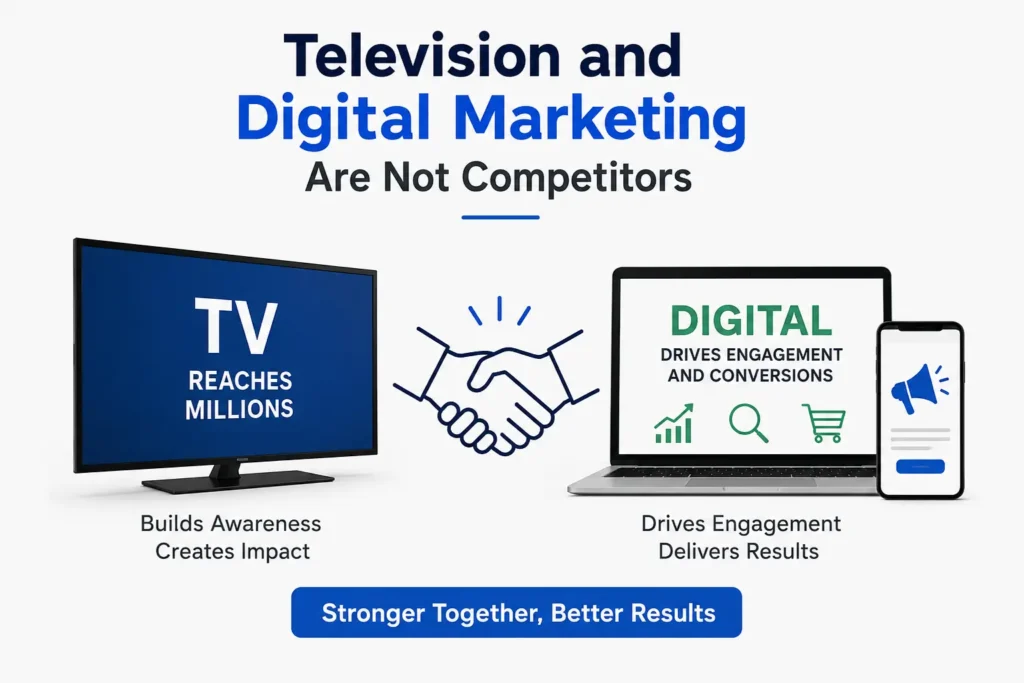
One of the biggest misconceptions in modern marketing is the belief that businesses must choose between television and digital advertising.
In reality, the strongest campaigns often use both.
Television introduces the brand.
Digital channels continue the conversation.
Search engines capture intent.
Landing pages generate leads.
Remarketing campaigns encourage action.
Each platform plays a different role in the customer journey.
Businesses that understand this relationship often achieve better results than those relying entirely on a single channel.
The future of advertising is not television versus digital.
It is television working alongside digital.