Types of Influencer Collaborations
Influencer marketing is not just about paying someone to post a picture with your product.
That was probably one of the first things brands did when influencer marketing became popular. Send a product, pay for a post, add a discount code and hope people buy it.
But things have changed.
Today, brands can work with creators in many different ways. A creator can make a short video, review a product, host a giveaway, attend an event, create content that the brand later uses in ads, or even work with the brand for several months.
The right type of collaboration depends on what the brand actually wants.
A company looking for sales may need a very different influencer campaign from a company that simply wants more people to know about its new product.
So, before choosing an influencer, it is worth understanding the different collaboration options.
What Is an Influencer Collaboration?
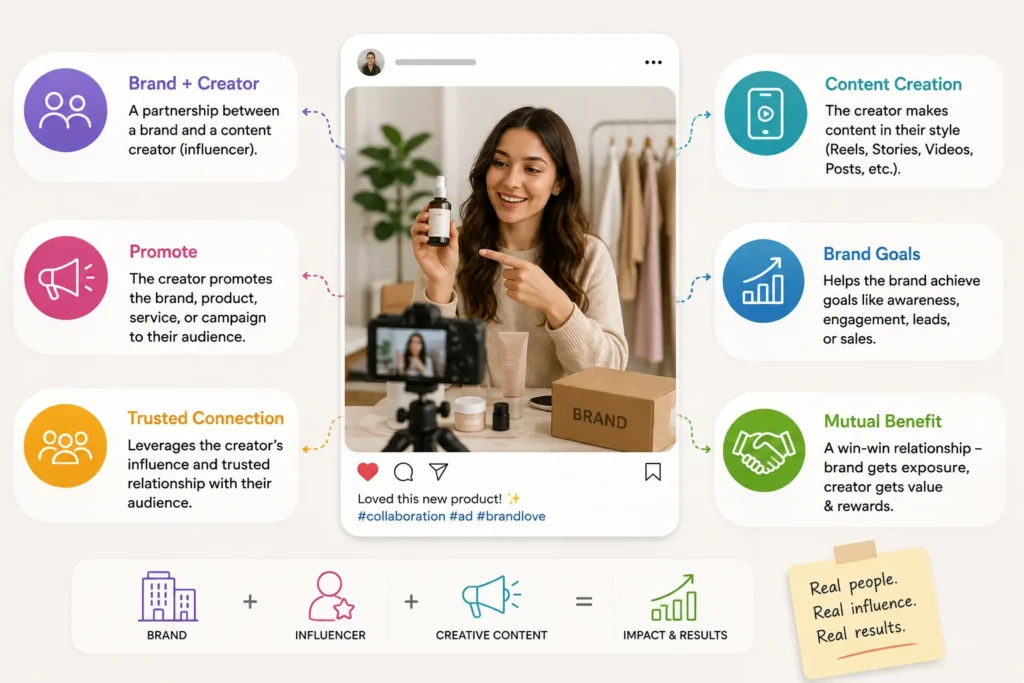
An influencer collaboration is a partnership between a brand and a creator where both work together to promote a product, service, campaign or idea.
The creator brings their content style and audience.
The brand brings the product, campaign idea, budget and marketing objective.
The collaboration can be a one-time post or something that continues for months.
There is no single format that works for every business.
1. Sponsored Social Media Posts
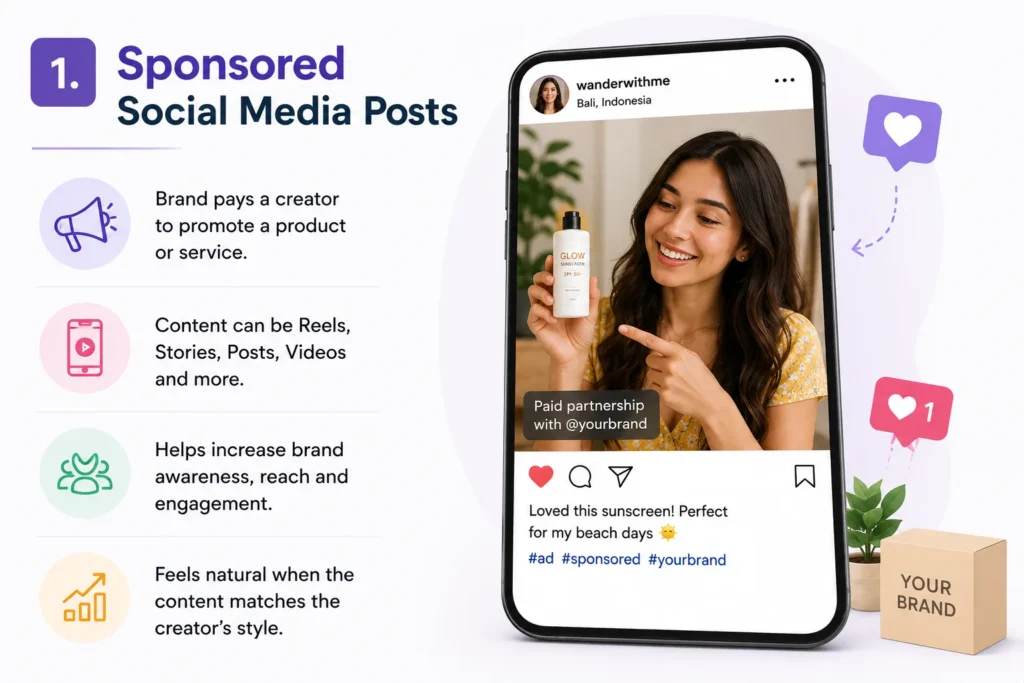
This is probably the most familiar type of influencer collaboration.
The brand pays a creator to publish content featuring its product or service.
It could be:
- An Instagram Reel
- A photo post
- A YouTube video
- A TikTok
- A Story
- A short product demonstration
The important part is that the content should still feel natural to the creator’s usual style.
If a creator normally makes simple, funny videos and suddenly posts a very formal advertisement, their audience may notice the difference immediately.
A good sponsored post doesn’t have to hide that it is sponsored. It just needs to make sense for the audience.
Sponsored content is one of the most common forms of influencer-brand partnership.
2. Product Gifting
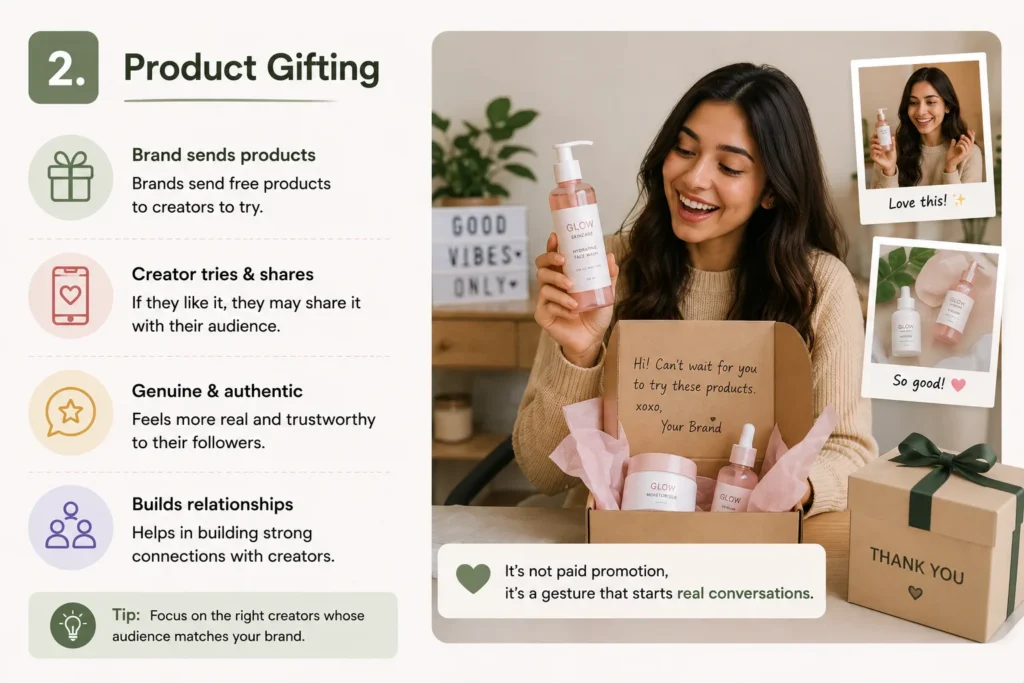
Not every influencer collaboration starts with a paid deal.
Sometimes a brand sends its product to selected creators and asks them to try it.
The creator may then decide whether they want to talk about it.
This can work especially well for products that are easy to demonstrate or experience, such as:
- Beauty products
- Food and beverages
- Clothing
- Gadgets
- Home products
- Travel products
But brands should understand one thing.
Sending a product doesn’t automatically guarantee a positive post.
Creators should be given enough freedom to give their genuine opinion. Otherwise, the content can start feeling forced.
3. Affiliate Collaborations
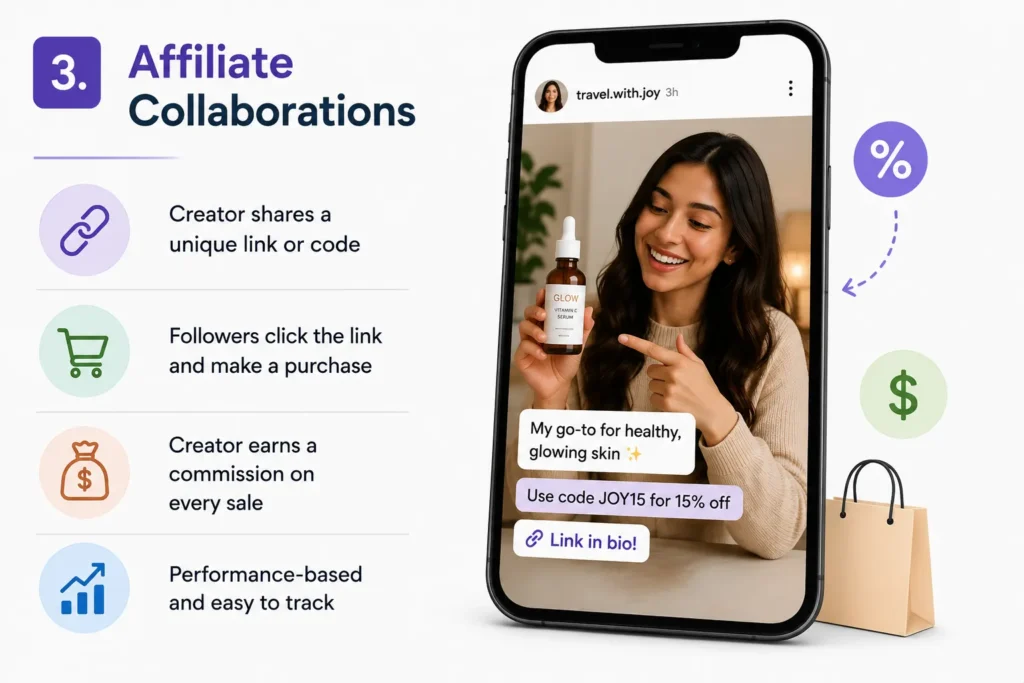
Affiliate influencer marketing is more directly connected to sales.
The creator receives a unique link or discount code. When someone makes a purchase through that link or code, the creator receives a commission.
For example:
A creator recommends a ₹2,000 product.
They share a unique discount code.
A follower uses the code and purchases the product.
The creator earns an agreed commission from that sale.
This model is useful because brands can track actual sales rather than only looking at views or likes.
It can also make sense for brands that want to work with several smaller creators instead of putting the entire budget into one large influencer.
Affiliate partnerships are specifically designed around performance and sales attribution.
4. Long-Term Brand Ambassadors
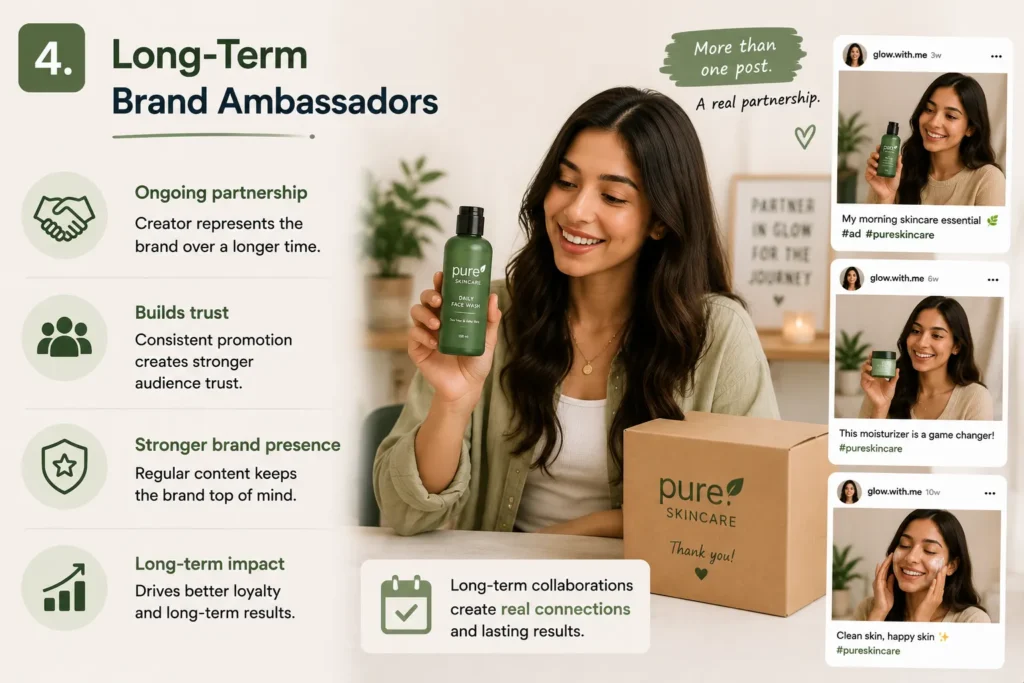
Instead of working with a creator once, a brand can build a longer relationship.
The creator may feature the product regularly over several months.
For example, a fitness creator might work with the same sportswear company throughout the year rather than promoting five different clothing brands every month.
This can make the relationship feel more believable.
People start seeing the creator using the product repeatedly instead of seeing it once and forgetting about it.
Long-term partnerships can also help brands build a group of reliable creators who understand the brand well.
5. Giveaway Collaborations
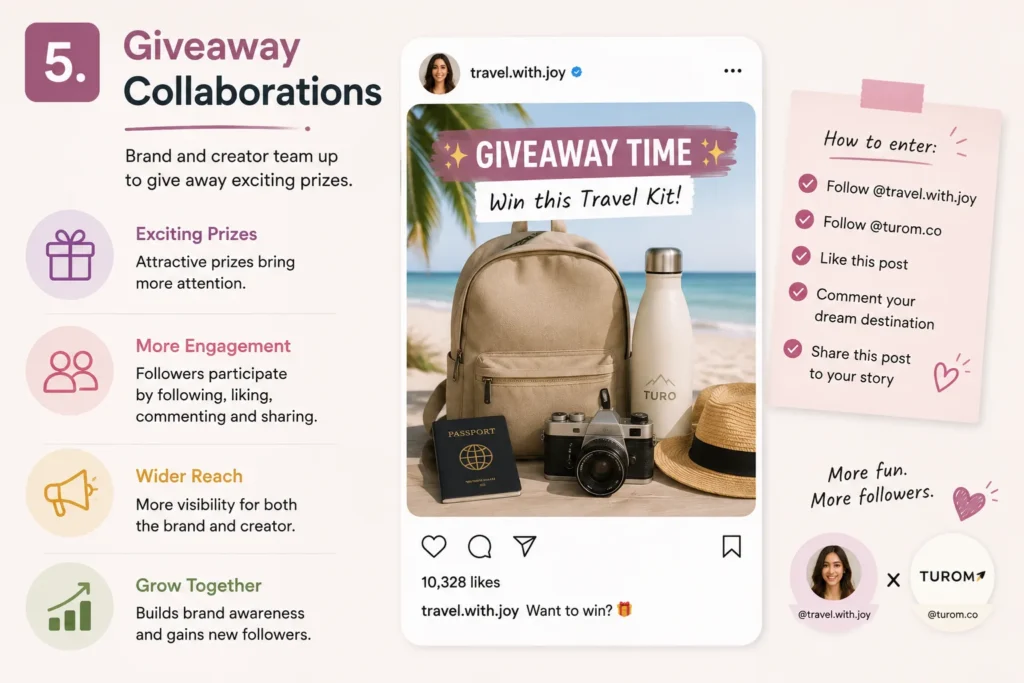
Giveaways are another popular option.
A brand and creator can work together to give away products, experiences or other prizes.
The campaign might ask people to:
- Follow the brand
- Follow the creator
- Comment
- Share the post
- Tag friends
Giveaways can quickly increase attention around a campaign, but they should have a clear purpose.
Getting thousands of people to follow a page doesn’t necessarily mean those people will become customers.
The quality of the audience matters more than simply increasing the follower count.
Brands should also check the rules that apply to contests and giveaways in the markets where they operate.
6. Influencer Takeovers
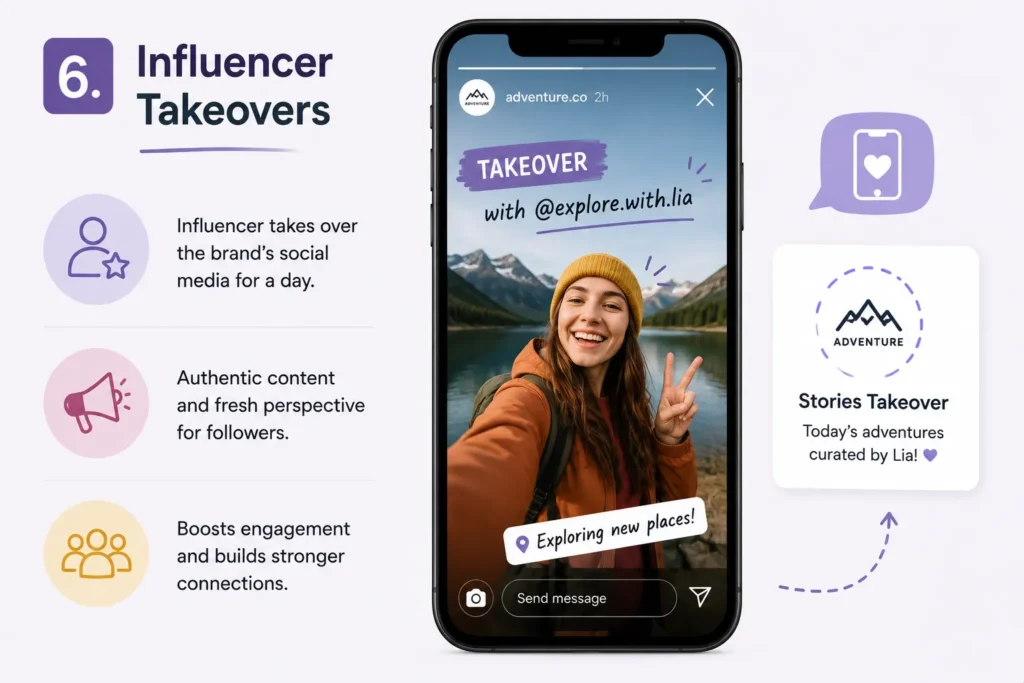
An influencer takeover is a little different.
Instead of the creator posting on their own account, they temporarily create content for the brand’s social media account.
For example, a travel creator could take over a hotel’s Instagram Stories for a day.
They might show:
- Their arrival
- The room
- Breakfast
- Activities
- Their experience at the property
The benefit is that the brand gets fresh content while the creator gets to bring their personality to the brand’s page.
Takeovers can be particularly useful when a brand’s own social content has started to feel repetitive.
7. Event-Based Collaborations
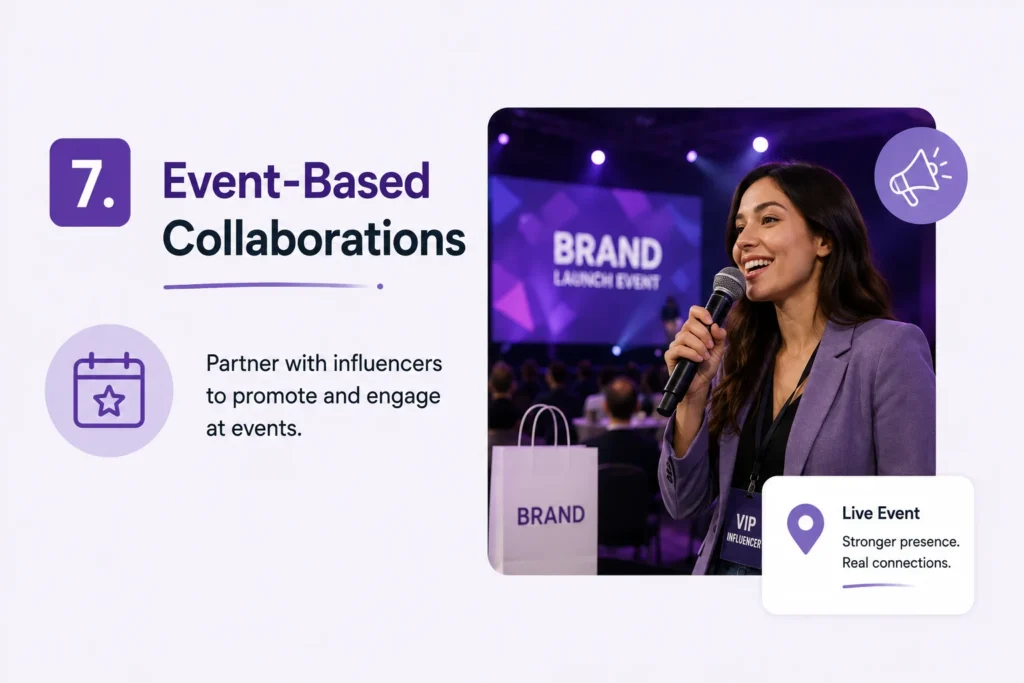
Brands can also invite creators to events.
This could be:
- A product launch
- Store opening
- Fashion event
- Conference
- Brand experience
- Restaurant opening
- Travel event
Creators can attend the event and create content while they are there.
This gives the brand content from multiple perspectives instead of relying on one professionally produced advertisement.
However, event collaborations need proper planning. Travel, accommodation, deliverables, posting dates and other expenses should be agreed upon before the event.
8. Product Review Collaborations
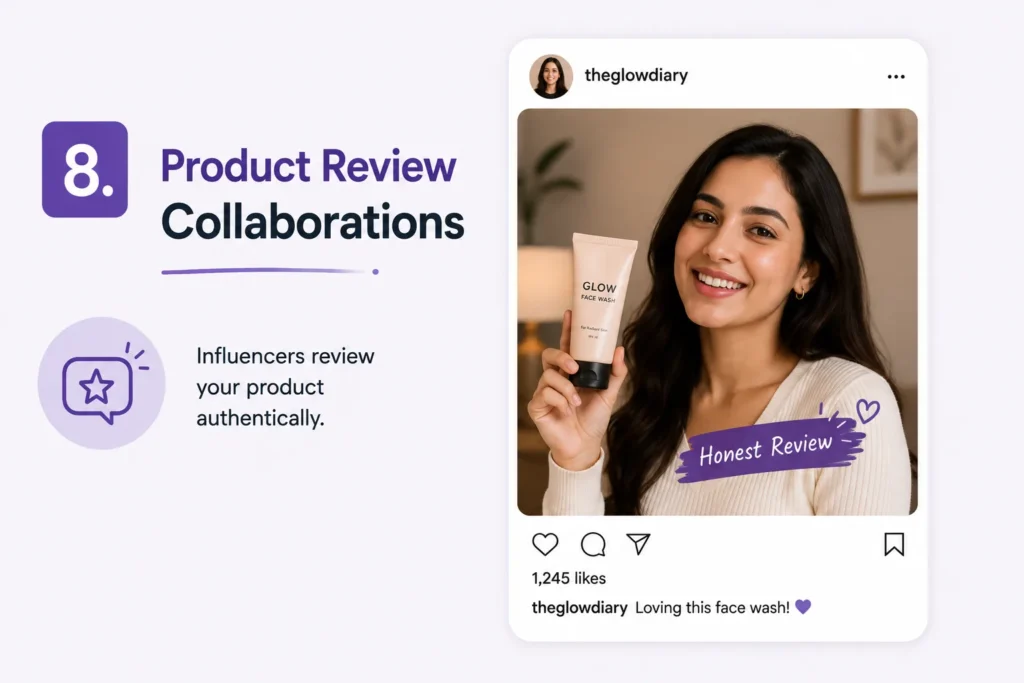
Reviews are useful when customers normally want to research a product before buying it.
A creator can explain:
- What the product does
- How they used it
- What they liked
- What could be better
- Who the product may be suitable for
This type of collaboration can work well for technology, beauty, fitness, travel, automobiles and many other categories.
The biggest mistake is trying to control every sentence.
If the review sounds like a company brochure, people may stop trusting it.
The creator’s honest experience is often the most valuable part.
9. UGC-Style Creator Content
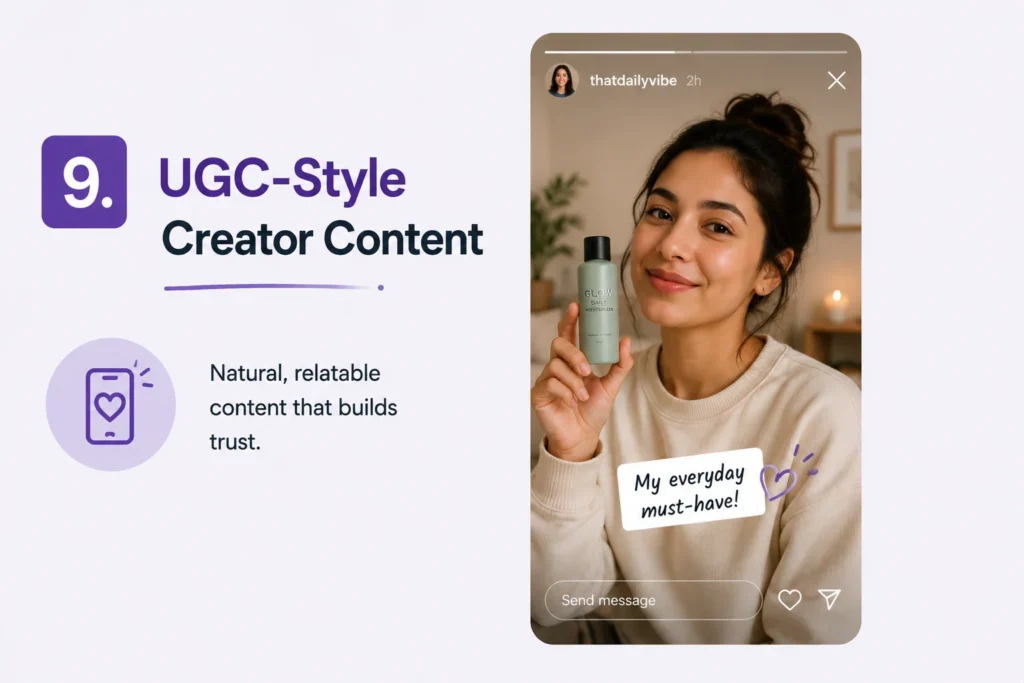
Here’s another collaboration that brands sometimes overlook.
The creator doesn’t necessarily need to publish the content to their own audience.
Instead, they create videos or photos that the brand can use on its own website, social channels or advertising campaigns, depending on the agreed usage rights.
For example, a creator might make:
- A product demonstration
- Unboxing video
- Testimonial
- “How I use it” video
- Before-and-after content
The brand can then use the content as part of its marketing.
This is especially interesting for paid advertising because creator-style content can feel different from traditional polished advertisements.
If a brand wants to reuse creator content in paid campaigns, however, the usage rights should be clearly agreed upon before the content is produced.
10. Creator-Led Paid Advertising
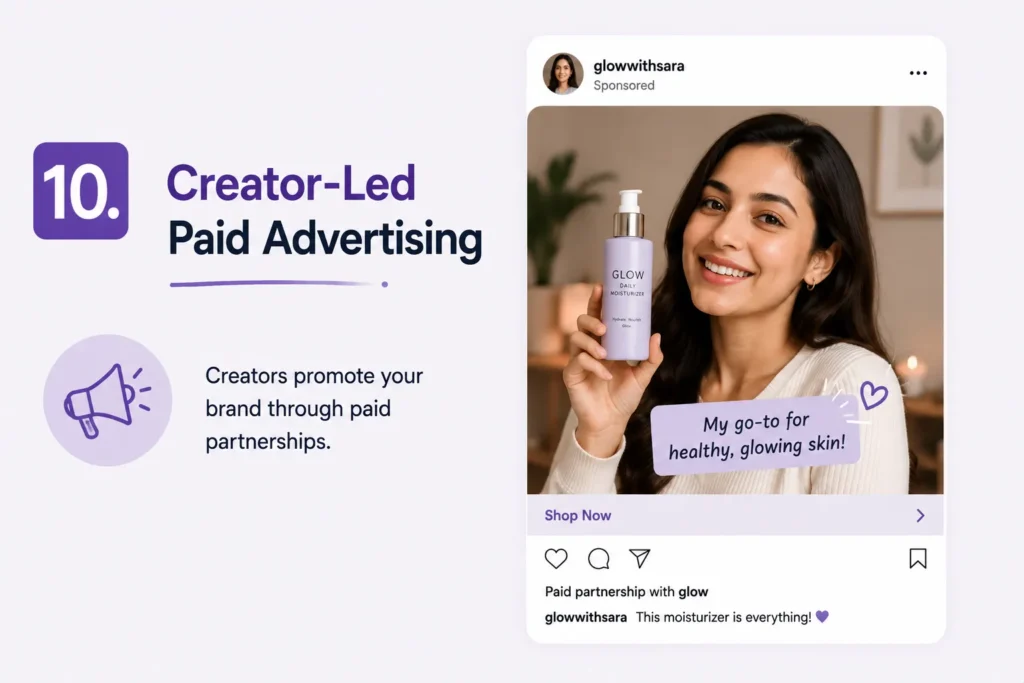
This is where influencer marketing and paid advertising start working together.
A creator makes the content, and the brand then uses that content in a paid campaign.
Instead of relying only on the creator’s organic reach, the brand can put advertising budget behind content that already fits a creator’s style.
This can be useful when a brand finds that a particular creator video performs well organically.
The brand can then test that creative with a wider targeted audience through paid advertising.
Creator content and paid social advertising can work together rather than being treated as completely separate campaigns.
11. Co-Created Products
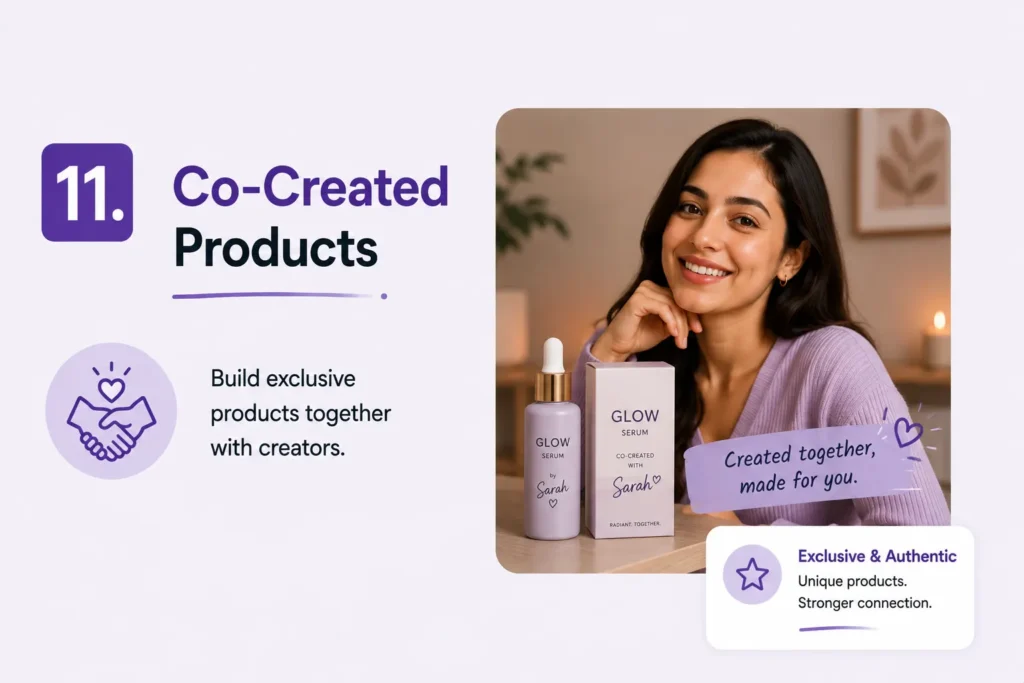
This is a bigger commitment.
Instead of simply promoting a product, the creator works with the brand to create something together.
For example:
A clothing brand works with a fashion creator to design a limited-edition collection.
A food company creates a special flavour with a popular food creator.
A beauty company launches a product developed around a creator’s audience.
This can create a stronger connection because the influencer is involved in the product itself.
But it also requires more planning, research and investment than a normal sponsored post.
12. Influencer Referral Programs
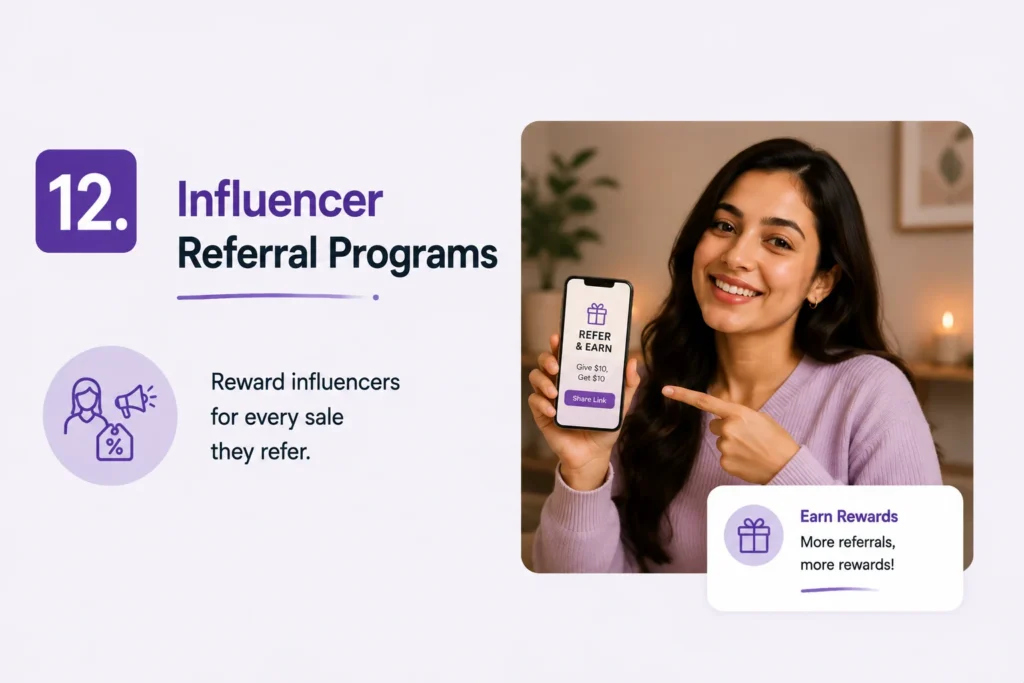
A referral program is similar to affiliate marketing, but the focus can be more on bringing new customers into the brand.
The creator receives a unique referral link or code.
Their followers use it to sign up, purchase or take another desired action.
The creator receives a reward based on the agreed terms.
For brands, this can be useful because the campaign becomes easier to measure.
Instead of asking:
“How many people saw the post?”
The brand can also ask:
“How many people actually took action?”
Which Influencer Collaboration Should You Choose?
This is where brands often make things unnecessarily complicated.
They start by looking for the biggest influencer they can afford.
That isn’t always the best approach.
Start with the campaign goal.
If your goal is awareness
Consider:
- Sponsored content
- Product launches
- Event collaborations
- Creator takeovers
If your goal is sales
Consider:
- Affiliate campaigns
- Referral programs
- Product reviews
- Creator-led paid advertising
If your goal is content
Consider:
- UGC
- Product demonstrations
- Unboxing videos
- Creator photos and videos
If your goal is long-term trust
Consider:
- Brand ambassadors
- Long-term creator partnerships
- Product collaborations
The same influencer can even be used in more than one format.
Don’t Choose an Influencer Only by Follower Count
A creator with 500,000 followers may look impressive on paper.
But what if only a small percentage of those followers are actually interested in your product?
A creator with 30,000 followers in a highly relevant niche could potentially be much more useful.
Look at things such as:
- Audience relevance
- Engagement
- Content quality
- Previous brand partnerships
- Audience location
- Comments and conversations
- Previous campaign performance
- Creator’s reputation
Also look at how the creator normally talks about products.
If every post is an advertisement, their recommendations may not have the same impact.
Give Creators Some Freedom
Brands obviously need control over important things like pricing, product information, claims and brand guidelines.
But creators should still have some freedom in how they present the message.
They understand their audience better than a brand does.
A simple brief can work better than a script that tells the creator exactly what to say.
The goal is not to make the creator sound like the brand’s marketing department.
The goal is to help the creator communicate the brand message in a way their audience understands.
Set Clear Expectations Before the Campaign
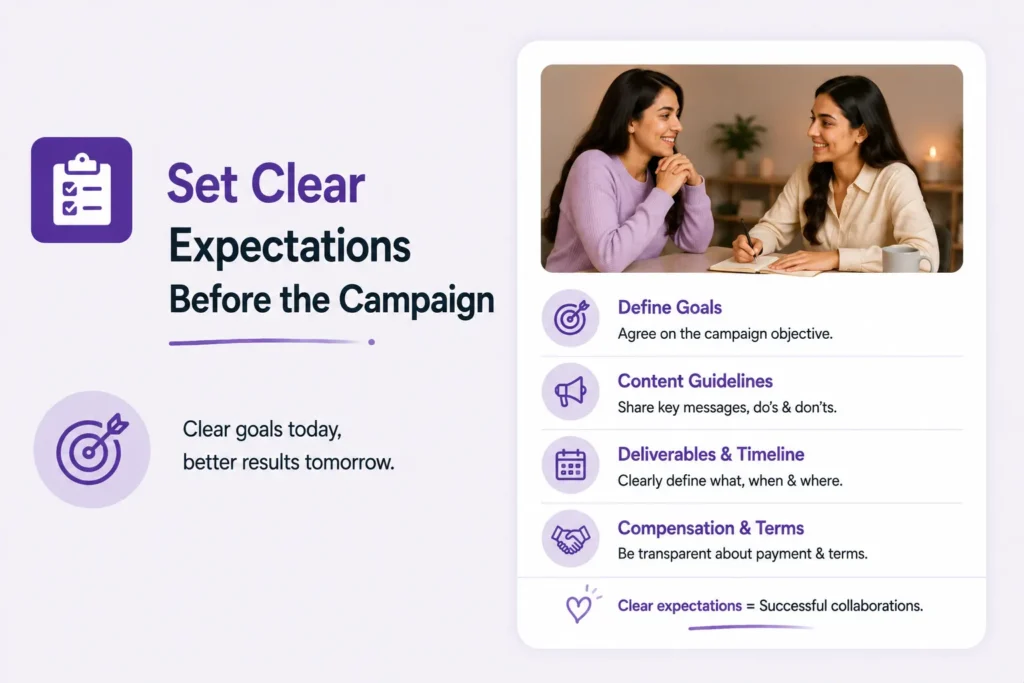
Many influencer campaigns become messy because both sides have different expectations.
Before starting, agree on:
- Number of posts
- Content format
- Posting dates
- Payment
- Product requirements
- Approval process
- Usage rights
- Exclusivity
- Tracking links or discount codes
- Reporting requirements
This becomes especially important when the brand wants to reuse influencer content for advertising.
A written agreement can prevent confusion later.
Measure More Than Likes
Likes are easy to see.
But they aren’t always the most important number.
Depending on your campaign, you might track:
- Reach
- Views
- Engagement
- Website visits
- Leads
- Product sales
- Discount-code usage
- Affiliate revenue
- Cost per acquisition
- Return on ad spend
The right metric depends on the reason you started the campaign.
If your goal is sales, millions of views with no purchases should make you stop and ask why.
Influencer Marketing Doesn’t Have to Be a One-Time Campaign
One of the biggest opportunities for brands is building relationships instead of constantly starting from zero.
A creator who understands your product can become much more useful over time.
They already know the brand.
They know what their audience responds to.
And the brand already knows how their content performs.
That makes future campaigns easier to plan.
It also gives the audience a chance to see the product more than once, which can be important for building familiarity.
Final Thoughts
There isn’t one “best” type of influencer collaboration.
A sponsored Reel might be perfect for one brand.
An affiliate campaign might work better for another.
A long-term ambassador may make sense for a brand that wants to build trust, while UGC could be more useful for a company that mainly needs better advertising content.
The important thing is to start with the objective instead of starting with the influencer.
Ask what you want the campaign to achieve.
Then choose the creator, collaboration type, content format and payment model around that goal.
That’s usually a much better way to spend an influencer marketing budget.
FAQs
What is the most common type of influencer collaboration?
Sponsored content is one of the most common forms. A brand pays a creator to publish content featuring its product or service. The exact format can be a Reel, video, Story, post or another type of content.
Are influencer collaborations only for big brands?
No. Smaller businesses can also work with niche and smaller creators. In some cases, a smaller creator with a highly relevant audience may be a better fit than a large creator with a broad audience.
What is the difference between affiliate marketing and sponsored content?
With sponsored content, the creator is generally paid for producing or publishing the agreed content. With affiliate marketing, the creator earns a commission based on tracked sales or other agreed actions.
What is a brand ambassador?
A brand ambassador is a creator or public personality who works with a brand on a longer-term basis and regularly promotes or represents the brand.
Can brands use influencer content in PPC ads?
Yes, creator content can potentially be used as advertising creative when the brand has the appropriate usage rights. This can connect influencer marketing with paid advertising and give brands additional creative options.
Should brands choose influencers based on followers?
Not only. Audience relevance, engagement, location, content quality and previous campaign performance can be more useful indicators when selecting a creator.
How long should an influencer collaboration last?
There is no fixed answer. A campaign may last for one post, a few weeks, or several months. The right duration depends on the campaign objective and the type of relationship.
Should influencers have complete freedom over sponsored content?
Creators should have room to use their own voice, but brands should still provide clear guidelines around important product information, claims, brand requirements and legal disclosures.
How can brands measure influencer campaign success?
Use metrics that match the campaign goal. Awareness campaigns may focus on reach and views, while sales campaigns may focus on conversions, revenue, CPA or ROAS.
What should be included in an influencer agreement?
The agreement should clearly cover deliverables, payment, deadlines, approvals, usage rights, exclusivity where applicable and any tracking requirements.
Want to Turn Creator Attention Into Actual Results?
Influencer marketing can bring attention to a brand, but attention is only one part of the customer journey.
The next step is making sure the right people actually see the brand again when they are ready to search, compare or buy.
Adworth Media Pvt Ltd helps brands with digital and performance-focused marketing, including paid advertising. Its work also includes influencer collaborations and performance marketing, making it possible to look at creator campaigns and paid promotion as parts of a wider marketing strategy.
If you’re planning an influencer campaign and want to support it with targeted PPC advertising, Adworth Media can help you build a paid campaign around the audience, offer and business goal rather than simply putting more money behind content.
The idea is simple: don’t stop when people notice your brand. Give them a clear reason and an easy path to take the next step.